




Batch vs. continuous oil refining: What's the difference for a small edible oil factory?
FAQ / Chat on line / Give me a price / Date:September 29, 2026
Choosing the right oil refining method is one of the most important decisions for a small edible oil factory (1–20 TPD). The three options—batch, semi-continuous, and full-continuous refining—differ significantly in capacity, investment cost, operational complexity, and product consistency. For small edible oil factories, batch refining offers the lowest entry cost and maximum flexibility, while semi-continuous refining provides a practical upgrade path with better efficiency and FFA recovery. Full-continuous refining (30–1200 TPD) is engineered for large-scale operations and is not suitable for small-scale production. Therefore, Glory Oiltech (Henan Glory) compares batch and semi-continuous refining based on key parameters to help you make an informed choice.
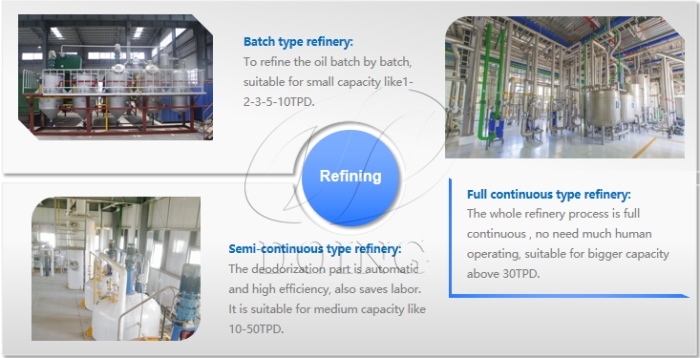 Three edible oil refining methods
Understanding the Three Refining Modes
Our oil refining solution is generally classified into three modes based on production scale and automation level:
| Mode | Typical Capacity | Core Characteristic |
|---|---|---|
| Batch Refining | 1–20 TPD | Processes oil in discrete batches (“one pot at a time”) |
| Semi-Continuous Refining | 5–30 TPD | Degumming, deacidification, and bleaching batch; deodorization continuous (using deodorizing tower with FFA recovery) |
| Full-Continuous Refining | 30–1200+ TPD | Entire line runs continuously without stopping |
Key point: When people say “continuous refining,” they may mean semi-continuous, full-continuous, or both. For a small factory operating at 1–20 TPD, understanding this distinction is crucial because only batch and semi-continuous are practical options—full-continuous is engineered for large-scale operations well above your production scale.
Batch Refining: The Standard Choice for Small Factories
Batch refining processes oil in discrete batches. Each stage—degumming, deacidification, bleaching, and deodorizing—is carried out in separate tanks, one step at a time. Based on Glory Oiltech's engineering data, a complete batch cycle typically takes 18–24 hours depending on oil type, FFA content, and specific equipment configuration. In practice, batch refining systems are reliable and versatile, but not designed for sustained large-scale production.
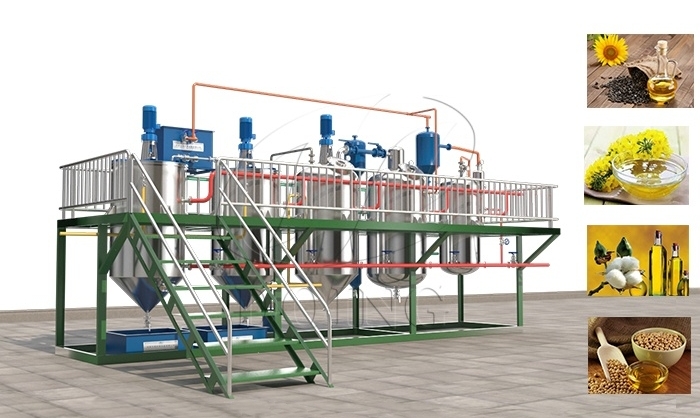 Batch type edible oil refining machine
Equipment Configuration
(1) A typical batch edible oil refining line includes:
(2) Refining tank (degumming & deacidification)
(3) Bleaching tank
(4) Deodorizing tank
(5) Leaf filter
(6) Vacuum system
(7) Thermal oil heater (or steam generator)
(8) Cooling tower (outdoor)
Advantages
Low investment cost—ideal for startups and small budgets
Flexible oil switching—easy to clean and switch between different crude oil types (palm, soybean, sunflower, etc.)
Simple operation—minimal PLC automation; workers can be trained quickly
Small footprint—fits in compact workshops; low building height requirements
Limitations
Higher per-ton consumption—steam, water, and chemicals per ton of oil are significantly higher than continuous methods
Higher soapstock oil content—approximately 40% oil retained in soapstock (vs. approximately 30% in continuous)
Labor intensive—more manual operation required
Best For
Small factories with 1–20 TPD capacity, multi-oil-type processing needs, limited budgets, or those in the early stages of market testing.
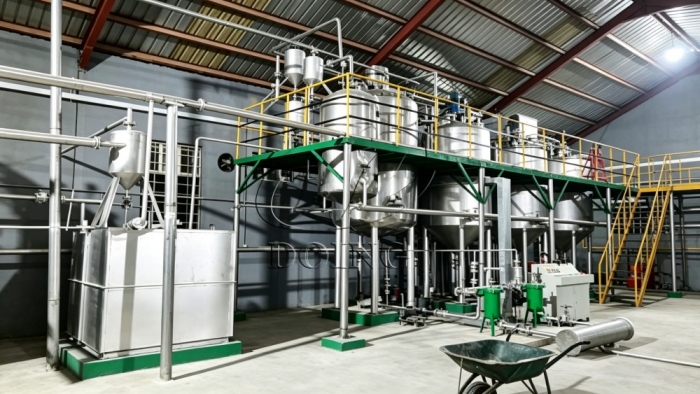 Batch type edible oil refining machine
Semi-Continuous Refining: The Smart Upgrade Path
Semi-continuous refining is a hybrid approach that combines the flexibility of batch processing with the efficiency of continuous operation. Specifically:
- Degumming, deacidification, and bleaching are carried out in batch mode (using tanks)
- Deodorization uses a continuous deodorization tower instead of a batch deodorizer
This design allows the factory to recover valuable Free Fatty Acids (FFA) as a by-product while maintaining operational flexibility. From an engineering perspective, the semi-continuous configuration offers the best balance of investment, efficiency, and flexibility for growing operations.
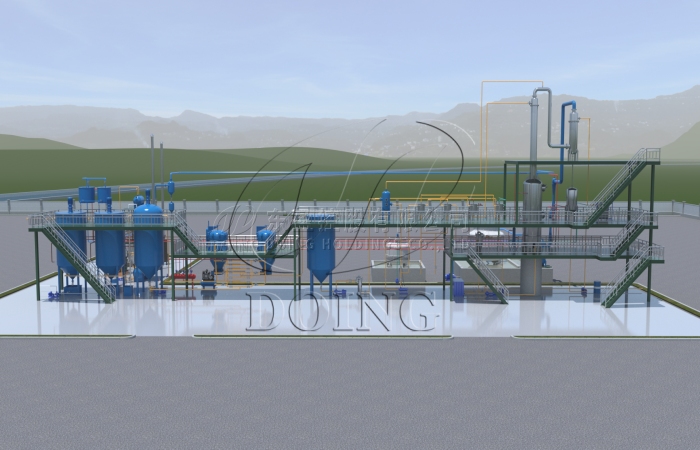 Semi-continuous edible oil refining machine
Equipment Configuration
A typical semi-continuous line includes:
(1) Refining tank (degumming & deacidification)
(2) Bleaching tank
(3) Leaf filter
(4) Deaeration tank
(5) Plate heat exchanger
(6) Cooler
(7) Continuous deodorization tower
(8) FFA collector (for fatty acid recovery)
(9) Thermal oil heater system
(10) Steam boiler system
(11) Vacuum system
Advantages
Higher energy efficiency—continuous deodorization with heat recovery via plate heat exchangers
FFA recovery revenue—fatty acids can be sold as a valuable by-product
Lower investment than full-continuous—significant cost savings on equipment and installation
Better oil quality consistency—continuous deodorization provides more stable results than batch deodorizing
Limitations
Hybrid complexity—managing both batch and continuous sections requires more skilled operators
Not fully automated—still requires manual intervention for degumming/deacidification/bleaching stages
Best For
Factories with 5–30 TPD capacity that want to upgrade from batch processing, recover FFA revenue, and improve efficiency without the massive capital outlay of a full-continuous line.
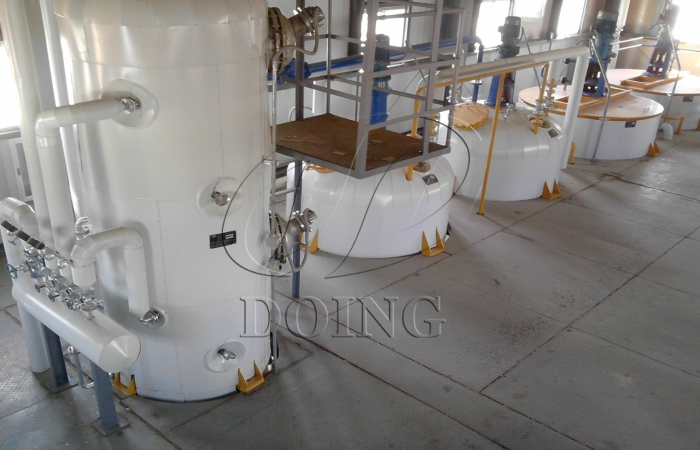 Semi-continuous edible oil refining machine
Comparison of Batch and Semi-Continuous Oil Refining
The following table summarizes the key differences based on Glory Oiltech's engineering data:
| Parameter | Batch Refining | Semi-Continuous Refining |
|---|---|---|
| Capacity | 1–20 TPD | 5–30 TPD |
| Operation Mode | All stages batch | Degumming/deacid/bleach batch + deodorizing continuous |
| Investment Cost | Low | Medium |
| Automation Level | Manual / Semi-auto | Hybrid (partial auto) |
| Steam Consumption (per ton) | ∼350 kg | ∼360–420 kg |
| Electricity (per ton) | 41.5-56.5 kWh | ≤28 kWh |
| Bleaching Earth (per ton) | 20–30 kg | ≤8–20 kg |
| Oil Type Flexibility | High (easy switching) | Moderate |
| Footprint | Small | Medium |
| Best Suited For | Small factories, multi-oil, limited budget | Growing small factories, efficiency upgrade |
Project References
Glory Oiltech has delivered refining solutions across Africa, Southeast Asia, and South America. The following are representative Project References:
| Project | Location | Capacity | Refining Type | Status |
|---|---|---|---|---|
| Palm Kernel Oil & Soybean Oil Refinery | Nigeria | 5 TPD | Batch refining | Completed |
| Palm Oil Refining & Fractionation Plant | Kenya | 10 TPD | Semi-continuous refining | Completed |
| Crude Palm Oil Refinery | Indonesia | 5 TPD | Semi-continuous refining | Completed |
| Crude Olive Oil Refinery | Peru | 20 TPD | Batch refining | Completed |
Common Selection Mistakes to Avoid
Choosing equipment based on price alone—without factoring in long-term operating costs, yield losses, and energy consumption can cost you far more than the initial savings.
Installing continuous systems without a stable crude oil supply—continuous refining requires consistent feedstock; intermittent supply will cause production bottlenecks and quality inconsistency.
Ignoring future expansion when designing the initial plant—reserving pipeline, electrical, and control interfaces early can significantly reduce upgrade costs down the line.
Which One Should Your Small Edible Oil Factory Choose?
For a small edible oil factory (1–20 TPD), here is our recommendation:
Choose Batch Refining If:
- Your daily capacity is 1–20 TPD
- You have a limited initial budget
- You plan to process multiple oil types (palm, soybean, sunflower, etc.)
- You prefer simple operation with minimal training
- You are testing the market or operating at a small scale
Choose Semi-Continuous Refining If:
- Your daily capacity is 15–20 TPD (upper end of small factory range)
- You want to recover FFA as an additional revenue stream (especially if your crude oil has FFA above 5%)
- You need better energy efficiency than batch provides
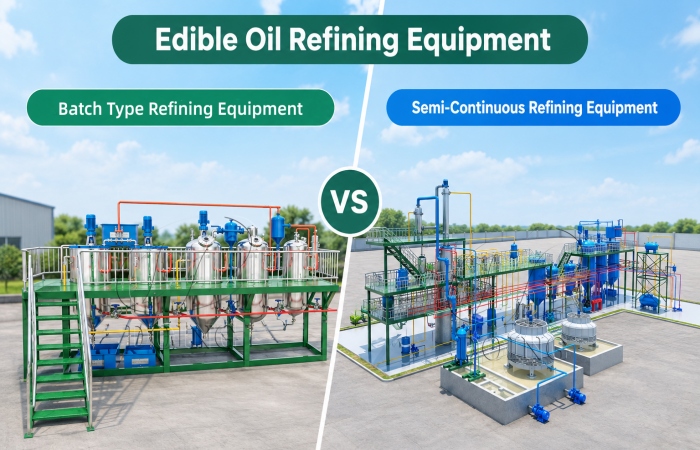 Comparison of batch and semi-continuous oil refining
Frequently Asked Questions
Can I upgrade from batch to semi-continuous refining later?
Yes. Many of our clients start with a batch line and upgrade to semi-continuous as their business grows. The upgrade typically involves adding a continuous deodorization tower and FFA recovery system while retaining existing tanks. Glory Oiltech designs our batch lines with future expansion in mind, making the upgrade path smoother and more cost-effective.
What utility requirements should I check before installing a refining plant?
Before purchasing equipment, verify your site has: electricity supply (typically 380V/50Hz, check kVA requirement based on capacity), steam generation capacity (boiler size based on refining mode), cooling water supply (cooling tower or river/lake water), compressed air system, and adequate drainage. Glory Oiltech’s engineering team provides a complete utility checklist during the consultation phase to ensure your site is ready.
How long does installation take for a small batch refining plant?
A typical 1–20 TPD batch refining plant can be installed and commissioned within 2–4 weeks, depending on site readiness and local labor availability.
Is batch refining capable of producing food-grade refined oil?
Yes. Batch refining can produce refined, bleached, and deodorized RBD edible oil that meet international food-grade standards. The key factors are proper process control (temperature, vacuum level, chemical dosing) and quality raw materials (crude oil quality and bleaching earth). Many of our small factory clients in Africa and Southeast Asia successfully produce food-grade oil with batch lines.
Ready to Start Your Edible Oil Refining Project?
Ready to get started? Contact Glory Oiltech today for a free consultation and customized quotation. Tell us about your oil type, expected capacity, and budget — our engineering team will recommend the optimal edible oil refining solution for your project, whether it’s batch, semi-continuous, or full-continuous design.
contact us
Kindly leave your message in below form. Our engineer will contact you ASAP once we got your message.
- QWhat is your raw material?
- QHow many tons do you want to process per day?
- QWhat machine do you want? or other requirement?