




100TPD soybean oil processing plant: expanding pressing vs expanding extraction
FAQ / Chat on line / Give me a price / Date:October 16, 2026
Starting a 100TPD soybean oil processing plant is a significant investment that requires careful selection of the right processing route. For project developers, the core issue is not "how to extract oil from soybeans", but which process best suits your needs.
At Glory Oiltech (Henan Glory), we work with clients on two primary routes for soybean oil processing plant projects: Expanding + Pressing (lower investment, residual oil rate of 4–6% after expanding, suitable for budget-conscious operators) and Expanding + Solvent Extraction (low residual oil rate below 1%, higher extraction yield, but requiring solvent handling infrastructure and higher initial investment). This guide compares both routes across residual oil rate, investment threshold, by-product value, and operational complexity — so you can make an informed decision for your 100TPD project.
What Are the Two Main Processes for 100TPD Soybean Processing?
Route A: Expanding + Pressing
Process flow: Cleaning → Destoning → Magnetic Separation → Crushing → Expanding → Oil Pressing → Filtration → Crude Oil + Cake
Route B: Expanding + Solvent Extraction
Process flow: Cleaning → Destoning → Magnetic Separation → Crushing → Expanding → Drying → Solvent Extraction → Miscella Evaporation and Stripping, Wet Meal Desolventizing, Solvent Recovery → Crude Oil + Meal
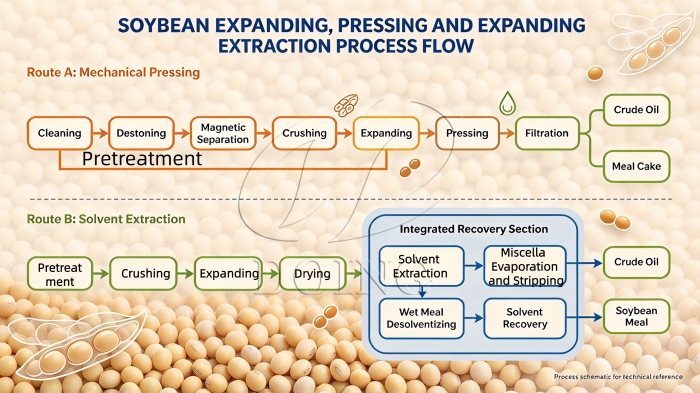 Soybean oil extraction process flow
Route A — Expanding + Pressing: Process Details & Residual Oil Rate
Pre-treatment Stage
Raw soybeans first pass through a vibrating screen to remove large impurities, then a destoner to remove stones and dirt, followed by a magnetic separator to capture metal fragments. The cleaned beans are then crushed by a double-roller crusher into 6 to 8 pieces.
Expanding Stage
The crushed soybeans enter the expander where they are subjected to approximately 140°C temperature and mechanical pressure. The expander squeezes the material into porous pellets, breaking down cell structures to significantly improve oil release during pressing. This is a key differentiator: after expanding, the residual oil rate drops to 4–6%, compared to about ≤8% if you skip expanding and press only cleaned, crushed beans.
Pressing & Filtration Stage
The expanded material feeds into screw oil presses where mechanical pressure extracts crude oil. The remaining cake contains the residual oil and is discharged for further processing or sale. The crude oil then passes through a filter to remove fine solids, producing clean filtered crude soybean oil ready for storage or further refining.
After pressing, the by-product cake (protein ~40%) can be bagged directly and sold as animal feed, providing an additional revenue stream.
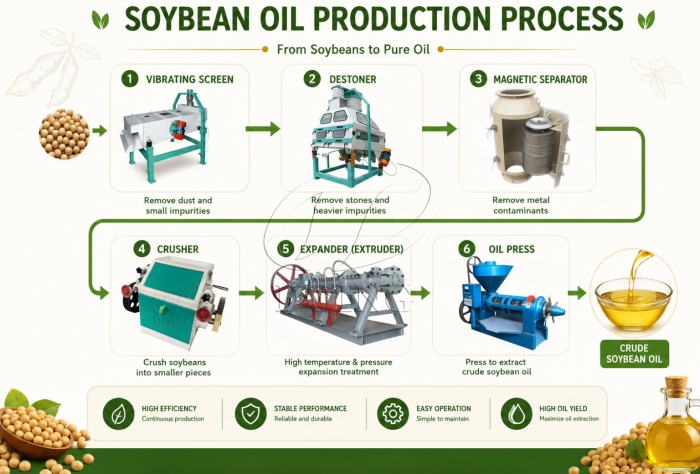 Soybean oil expanding-pressing process
Advantages & Limitations
Advantages: Saves on softening machine, flaker, and cooker — resulting in lower initial investment and good cost-performance ratio. The overall process is simplified, and the by-product cake has a ready market as animal feed.
Limitations: The residual oil rate (4–6%) is higher than what solvent extraction achieves, meaning slightly more oil is left in the cake.
Route B — Expanding + Solvent Extraction: Process Details & Residual Oil Rate
Pre-treatment Stage
Raw soybeans undergo cleaning, destoning, magnetic separation, and crushing — identical to Route A up to this point. After crushing, the material enters the expander where it is pelletized at elevated temperature. This shared front end is what makes the soybean oil extraction process a natural upgrade rather than a new build. The expanded pellets then pass through a flat-bed dryer to reduce moisture to the optimal level for solvent penetration.
Solvent Extraction Stage
In the soybean oil extraction process, the dried, expanded material feeds into an extractor where food-grade n-hexane solvent dissolves the oil from the soybean meal. The resulting miscella (oil-solvent mixture) is sent to evaporation and stripping systems to separate crude oil from the solvent. The wet meal exits the extractor and passes through a desolventizer-toaster (DTDC) unit to remove residual solvent, producing final soybean meal with residual oil below 1%.
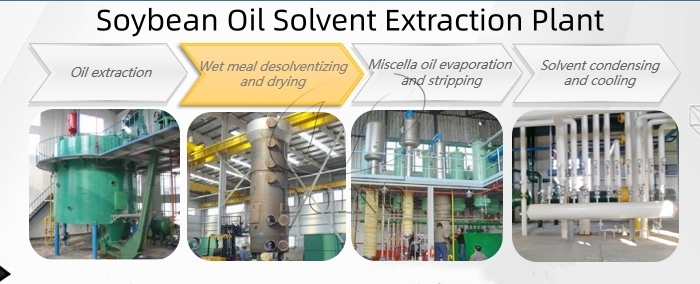 Soybean oil solvent extraction process
Key Performance Data
| Parameter | Value |
|---|---|
| Minimum viable scale | ≥20 tons/day |
| Solvent type | n-hexane (food-grade light petroleum ether) |
| Steam consumption | <280 kg per ton of material |
| Electricity consumption | <12 KWH per ton of material |
| Solvent consumption | <4 kg per ton of material |
| Water consumption | <25 kg per ton of material (recirculating) |
Advantages & Limitations
Advantages: A low residual oil rate (<1%) means the soybean oil extraction process recovers maximum oil from every ton of soybeans. The resulting meal has high protein content about 43%, commanding better prices in the feed market.
Limitations: Requires dedicated extraction equipment, solvent recovery system, and explosion-proof workshop design — resulting in higher initial investment. The crude oil produced requires refining (degumming, deacidification, bleaching, deodorization) before it can be sold as edible oil. Solvent handling requires trained operators and strict safety protocols.
Side-by-Side Comparison: Which Route Suits Your 100TPD Project?
| Comparison Dimension | Route A: Expanding + Pressing | Route B: Expanding + Solvent Extraction |
|---|---|---|
| Residual oil rate | 4–6% (after expanding) | Below 1% |
| Extraction rate | ~85–90% | Up to 99% |
| Cake/meal protein | 40% | 43% |
| Initial investment | Lower | Higher |
| Operational complexity | Low (simplified process, easier operation) | High (solvent management, explosion-proof safety) |
| By-product value | Cake can be directly sold as animal feed | Higher-protein meal suitable for premium feed market |
| Best suited for | Budget-conscious operators, markets with local cake demand, simpler operations | Operators seeking maximum oil recovery, high-protein meal markets, those with solvent handling experience |
A Strategic Advantage: Shared Pretreatment-Expander Means Future Upgrade Path
One often-overlooked advantage of these two routes is that both share the same front-end equipment. This means that when designing a 100TPD soybean oil processing plant, a client with a tighter budget can start with the expanding + pressing route, generate revenue and market presence, and later add the solvent extraction section when capacity expansion and additional budget allow — without tearing down and rebuilding the front-end equipment. This phased approach significantly reduces the risk of upfront capital commitment while keeping the door open for maximum oil recovery down the line.
Real Project Reference: 50TPD Expanding + Pressing Line in Nigeria
Our Nigerian customer visited our facility in July 2023 during the solution comparison phase. After evaluating multiple equipment suppliers, they selected Glory Oiltech based on our quality standards, technology capabilities, and local service advantage in Africa. The 50TPD soybean oil expanding pressing production line — including vibrating screen, destoner, magnetic separator, crusher, expander, screw presses, and filter press — was successfully installed and put into trial operation in March 2024, with stable equipment performance throughout.
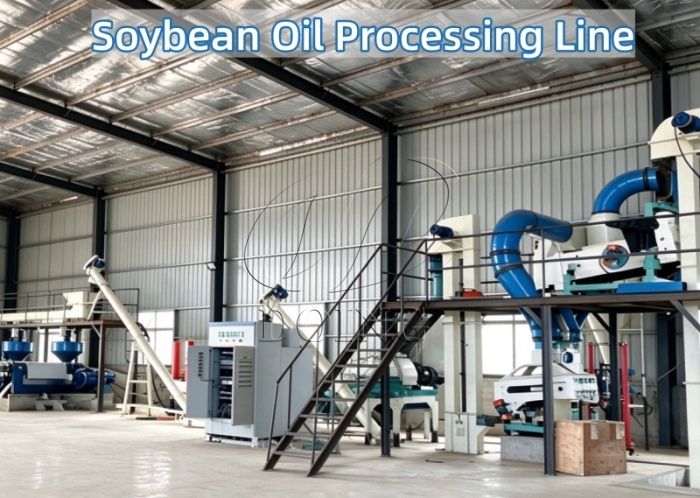 Soybean oil expanding-pressing plant project
At Glory Oiltech, we provide turnkey solutions across a capacity range of 1 to 2,000 tons per day, ensuring that whether you start small or plan big, the same proven technology and support team will be behind your plant.
FAQ
What hidden costs should I budget for beyond the equipment price?
Beyond the base equipment quote, budget for these often-underestimated items: (1) Site preparation — foundation work, electrical infrastructure, and civil engineering; (2) Power backup — many markets require generator backup, which is a separate capital item; (3) Solvent inventory and recovery — for extraction routes, n-hexane is a recurring cost though largely recycled; (4) Refining — crude oil from pressing or extraction needs refining (degumming, deacidification, bleaching, deodorization) before it can be sold as edible oil; (5) Spare parts stock — especially filter cloths, press screws, and expander liners; (6) Installation and commissioning — while our engineers stay on-site until full commissioning, logistics and accommodation costs should be factored in. A comprehensive turnkey quote from an experienced supplier should cover most of these items.
Is n-hexane safe for food-grade soybean oil production?
Yes, when properly managed. Food-grade n-hexane (also known as petroleum ether) is the industry-standard solvent used in the soybean oil extraction process worldwide. The key safety and quality controls are: (1) Solvent recovery rate — modern extraction systems recover over 99.9% of the solvent through condensation and distillation, leaving residual solvent in the meal below 500 PPM (well within international food safety limits); (2) Crude oil residual solvent — the final crude oil after evaporation and stripping contains less than 300 PPM residual solvent, which is further reduced during refining; (3) Explosion-proof design — extraction workshops must be designed as explosion-proof zones with proper ventilation, spark-proof equipment, and gas detection systems; (4) Operator training — trained personnel following standard operating procedures are the most critical safety factor. Glory Oiltech provides complete solvent management protocols and operator training as part of our turnkey delivery.
What protein content can I expect from soybean cake/meal at 100TPD scale?
The protein content depends on whether you dehull the soybeans before processing: Without dehulling, pressing cake contains approximately 40% protein, while extraction meal contains 43% protein. With dehulling, the meal protein can reach 45%–50%, which commands a premium price in the animal feed market. For operators focused on maximizing by-product revenue, investing in a dehulling step before extraction can significantly improve the profit margin on meal sales, even though it adds a front-end equipment cost.
Get Your Customized Soybean Oil Processing Solution
Choosing the right process for your 100TPD soybean project isn't about picking the "best" technology — it's about matching the right technology to your budget, your market, and your growth plans. Whether you start with expanding + pressing and upgrade later, or go straight to expanding + extraction, the key is working with a supplier who understands both processes inside out and can support you from equipment selection through commissioning and beyond.
At Glory Oiltech, we bring over a decade of experience in designing and delivering soybean oil processing plants. Our team of 40+ engineers backs every project from concept to commissioning.
Contact us today. Share your raw materials, target processing capacity, and intended final product — our engineering team will recommend the optimal configuration for your soybean oil processing plant.
contact us
Kindly leave your message in below form. Our engineer will contact you ASAP once we got your message.
- QWhat is your raw material?
- QHow many tons do you want to process per day?
- QWhat machine do you want? or other requirement?